Finding
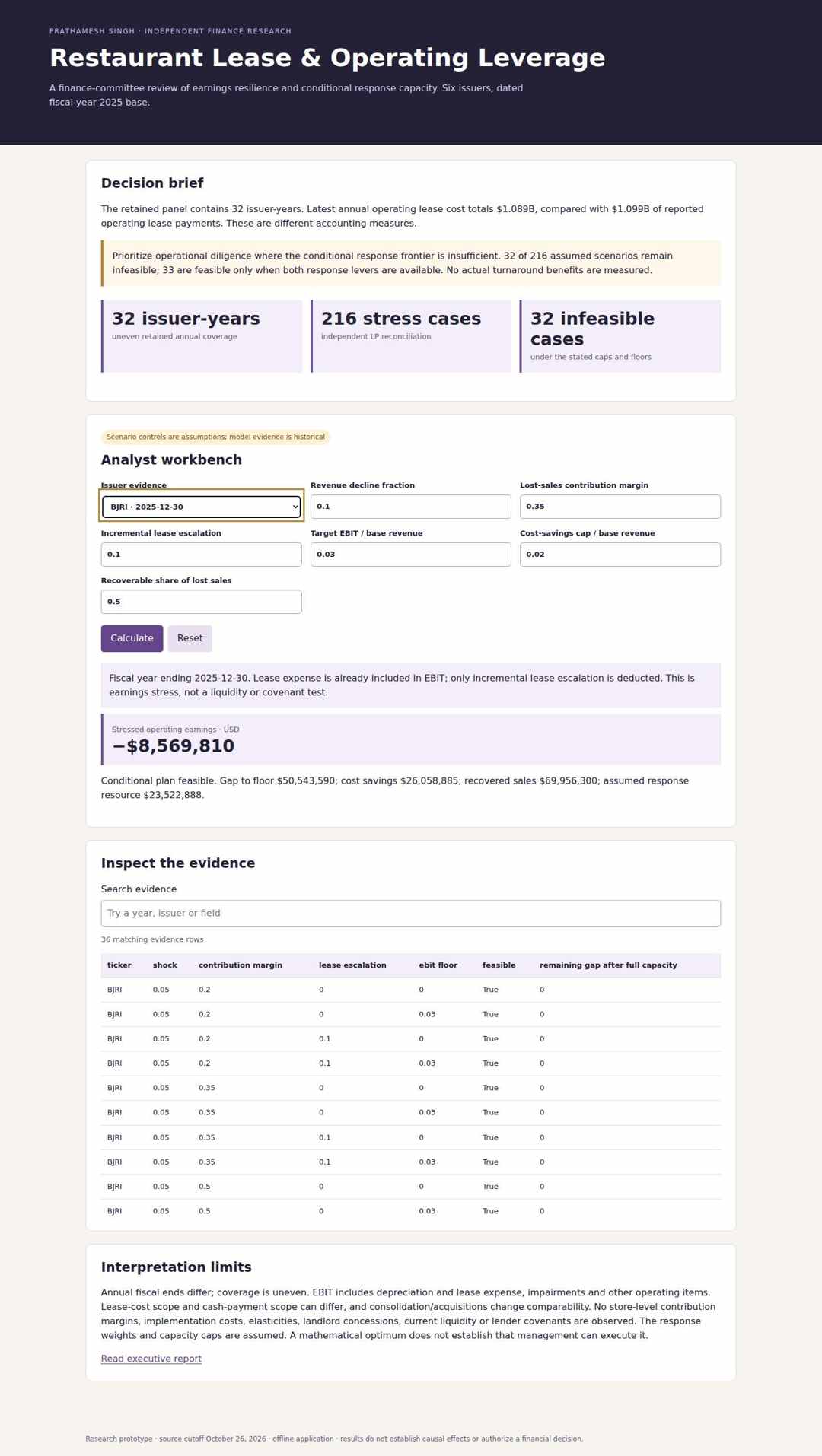
Selected FY2025 lease expense totals $1.089 billion, versus $1.099 billion in lease payments. Thirty-two of 216 reference cases cannot meet the assumed earnings floor within the response caps. Thirty-three are feasible only when both cost savings and sales recovery are available.
Why it matters
Investigate store contribution margins, lease resets, execution costs and credible sales recovery before approving a response. Earnings sensitivity alone does not establish liquidity or covenant headroom.
Who could use this
Restaurant corporate finance and operations committees investigating an earnings stress.
Data and scope
32 SEC company-years across six operators. Twenty-four latest source facts reconcile to six original filings; selected fiscal ends differ.
How the analysis works
Lease-aware earnings stress avoids deducting base rent already included in EBIT. A bounded two-lever response model is checked against independent linear programming across 216 cases, with 72 additional sensitivities.
Limits of the evidence
Sales shocks, contribution margins, resource weights and response caps are assumptions. Earnings and lease cash are different concepts. The exercise establishes no actual savings, current liquidity gap or covenant result.