Finding
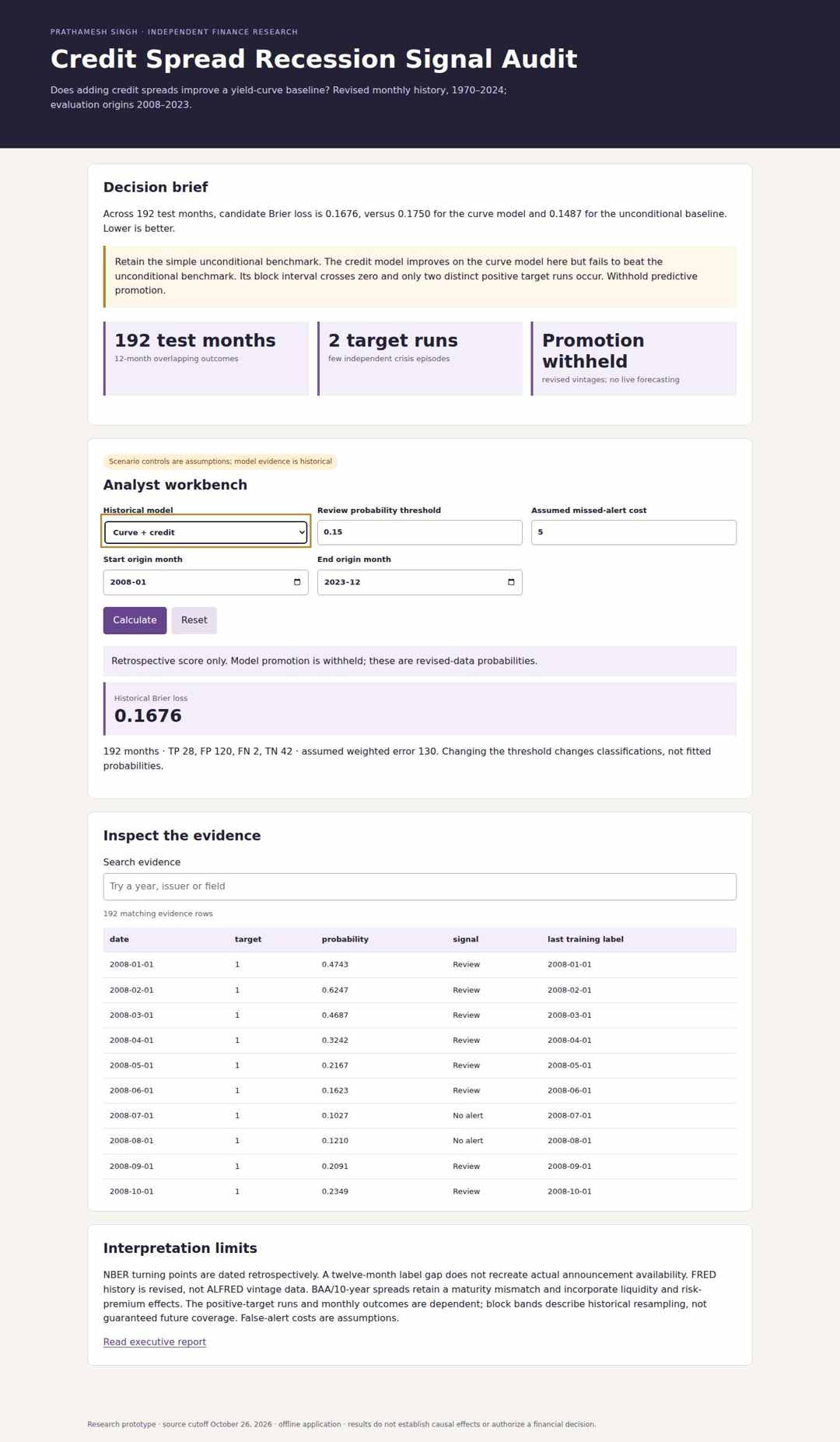
Across 192 held-out forecast dates, Brier loss is 0.1676 for credit plus curve, 0.1750 for the curve model and 0.1487 for the expanding historical baseline. Lower loss is better. The candidate therefore fails its simplest benchmark despite improving on the curve model.
Why it matters
Preserve the failed comparison and withhold approval. Testing another design requires new evaluation evidence, rather than retuning the reviewed test until it looks positive.
Who could use this
Credit-research model-governance reviewers assessing incremental predictive value.
Data and scope
Pinned monthly FRED spreads, Treasury yields and NBER recession labels: 648 panel origins, with 192 held-out origins from 2008–2023 and labels through 2024.
How the analysis works
Expanding logistic estimation uses prior-month features, a twelve-month label gap, training-only scaling and separate penalty selection. Curve and historical-probability baselines, paired blocks and SQL checks challenge the candidate.
Limits of the evidence
The paired uncertainty band crosses zero and testing includes only two separate recession-target episodes. Revised data and eventual NBER labels do not recreate real-time knowledge. This is not a live recession forecast or a validated trading signal.